FROM THE TOOLBOX · CONCEPTUAL SERIES
Efficiency.Why Easier Isn’t Cheating
What if the next improvement begins with noticing the effort you do not need?
A little less struggle. A little more discovery.
- Efficiency means appropriate effort for the task.
- Notice the first small change before compensating.
- Keep experiments comfortable, simple and unhurried.
- Use your red flag and diary to record what you discover.
In this article
What is the deckchair doing here?
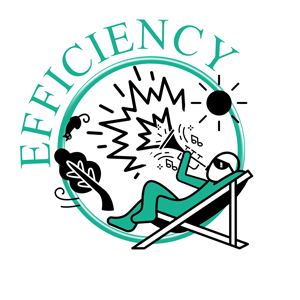
Our Efficiency icon features a trumpet player in a deckchair. Sunglasses on. Feet up. It is not the usual picture of someone working on their playing.
That is precisely why I like it. Many of us have learned to associate improvement with a visible struggle. If something becomes easier, we wonder whether we are doing enough. Surely there should be a little more suffering involved?
The deckchair is a reminder to question that assumption. It is not a recommended orchestral seating position. Efficiency means doing what the task requires, while noticing the extra activity we have added along the way.
What does efficient trumpet playing mean?
Efficient trumpet playing uses appropriate, coordinated effort for the musical task. The aim is to recognise and reduce unnecessary or involuntary muscle action, rather than trying to make every muscle switch off.
Playing involves movement. Breathing involves movement. Musical expression involves choices. The useful question is whether a particular action is helping, or whether it has become an automatic passenger on every note.
A note may sound perfectly acceptable while your shoulders lift, your jaw braces or your throat feels busy. Getting the note is one piece of information. How you got it is another. We want to become interested in both.
Why easier can feel suspicious
Familiar effort can become part of our definition of playing. We expect a certain amount of pressure or tension, so its absence can feel wrong—even when the task is going well.
Then we add the familiar effort back. A little push to make sure. A little squeeze for security. Brian the Brain likes a recognisable routine, even when the routine includes doing more than necessary.
When something feels easier, pause before correcting it. Listen. Notice. Repeat the comfortable task without chasing a bigger result. You are gathering information, and that takes a different kind of attention from trying to prove yourself.
Look for the first small change
Extra effort does not always arrive with flashing lights. It may begin as a tiny tightening before the note, a hurried breath or the thought, “This one had better work.” The dramatic struggle can come later.
This connects directly with Overblowing. If the response to uncertainty is always more air and more effort, it becomes difficult to see what prompted the uncertainty in the first place.
Bring your attention back to the moment before the compensation. What changed first? Keep the task small enough to observe that change. There is no prize for rushing past the useful information.
Try a small efficiency experiment
Choose a familiar note or very short phrase in a comfortable part of your playing. This is an observation exercise, so leave the personal best attempt for another time.
Play it once and notice what accompanies it. Are your shoulders joining in? Does your jaw brace before the sound? Do you hurry the breath? Choose just one thing to observe; a committee meeting about every muscle will not help.
Pause, return to a comfortable starting point and try again. Avoid forcing the area to relax or manufacturing a new position. Keep the musical task modest and notice whether the added activity appears at the same moment. If it becomes uncomfortable, stop and reassess.
Compare the process as well as the sound. An observation such as “My shoulders stayed quiet until I anticipated the next note” gives you somewhere specific to explore. “That was rubbish” gives you a bad review and very little else.
Your red flag marks a discovery
The red flag is a useful place to record the point where pure process starts becoming manipulated. It does not mean you have failed a lesson. It means you have found something worth examining closely.
Inside WindWorks, use the red flag area in your Practice Diary on the relevant lesson and add a short description. Be specific: “I start bracing before the second note” is more useful than “Range problem.” Your flag gives you a place to return with a clear purpose.
If an earlier lesson reveals the same response more clearly, you can move your flag back. Progress is not a race to keep the flag travelling forwards. It is learning to recognise what is happening with less guesswork.
Write down the small stuff
Your diary does not need a concert review after every practice. A sentence about what you noticed, when it happened and what you would like to explore next is plenty.
Try: “The first note felt easy. When I thought about going higher, my jaw tightened before I played. Next time I will observe that anticipation in a simpler task.” That note preserves a discovery you might otherwise forget.
Keep the wording curious. You are not collecting evidence against yourself. You are building a picture of your habits, one useful observation at a time.
Give the process time to become familiar
Impatience has a way of turning a small experiment into an audition. We notice something useful, then immediately ask whether it has fixed our range, endurance and entire musical future.
Stay with what you can observe now. Repeat a manageable task, leave room between attempts and resist adding effort simply because you want a result sooner. Understanding an idea and recognising it consistently in your playing are different stages of learning.
Continue with Stillness: Notice What You Don’t Need, or watch Greg’s original Stillness teaching to see how he introduces a quiet starting point for recognising unnecessary effort.
The deckchair is an invitation to bring less struggle and more attention to practice. Keep your curiosity switched on. Let the unnecessary extras have the afternoon off.