The Air Lock is Greg Spence’s term for a pinched lip closure that obstructs the airflow. Watch him distinguish the aperture corners from the corners of the mouth and introduce the Milk Spout and Bed Sheet concepts as alternatives to unnecessary squeezing.
Read the video transcript
Source: YouTube automatic captions, formatted for reading. Captions may contain errors; refer to the video for precise wording, sounds and demonstrations. Dates and offers reflect the original recording.
congratulations on wanting to take the shortcut to easier brass plane good day Greg speds from Mystery to Mastery here today we’re going to unlock the biggest obstruction to your playing the biggest obstruction to playing freely all over the instrument the obstruction to efficiency and that obstruction of course that we’re going to unlock is the air lock the air lock of the lips pinching down top lip bottom lip squeezing together there is a psychology that we have to buzz the lip and tighten them up when we’re
playing higher and all this does is actually increase the air lock what is the air lock if we put the lips together pinch them down p p p p pinch blow as hard as you can you cannot blow the lips apart there is so much strength in the umer especially around the middle of the lips there that you simply can’t blow them apart this is a massive error that just about everyone makes and it comes from a misunderstanding of how the instrument works and what we
think we need to do so how do we overcome that I’ve got a concept called the milk spout I’ve got a concept called the aperture Corners the corners of the aperture not the corners of the mouth I’ve got a concept called the bed sheet and once we understand those Concepts those amazing tools that we use in the course you’ll start to recognize that the pinch is the opposite of what you actually need to be doing the middle of that top lip and some people often say
just the skin on the top lip there needs to be like the bed sheet when the breeze blows they respond so to unlock your limitations and obstructions in your playing you really must discover how to let go unlock the lips let the lips go and let them respond sympathetically to the the energy in the air stream hey guys if you’re wanting my help to develop an efficient 3 to four octave range with consistency confidence a killer sound and a virtuoso technique I’ve put everything I’ve learned
over the last 35 years into one easy to follow program that you can benefit from right now at absolutely no cost for the next 7 days from your very first lesson you’ll begin to understand why you’re having playing problems and why hitting ceilings our step-by-step comprehensive technical development program is for all brass players of all levels and all styles and are run live weekly master classes and live lessons via Zoom to make sure you’re on the right track if your mind isn’t totally blown by day
seven you can opt out without being charged to [Music] sent
Stop pinching your trumpet sound: what is the Air Lock?
The Air Lock is Greg’s term for an overly pinched lip closure that obstructs the airflow. He contrasts that sensation with his aperture corners, Milk Spout and Bed Sheet concepts, encouraging observation of unnecessary squeezing.
This recording is part of Greg Spence’s public teaching archive. References to dates, events and offers reflect the original recording.
Explore the Air Lock: a guide to the demonstration
Air Lock: the question behind the demonstration
When trumpet playing feels difficult, it is tempting to assume that the answer must be more effort. Greg’s Air Lock lesson asks a different question: could the lips already be strong enough, while the way they are closing is obstructing the response? That is the distinction to listen for in this short video. He demonstrates an obstruction, then introduces concepts that help explain what he wants to change.
The purpose of this guide is to keep those ideas separate and easy to revisit. It follows Greg’s explanation rather than adding a new exercise routine. You can watch the video first, then open the sections that address your question. The physical demonstrations, sounds and original teaching remain in the recording above.
1. Identify what Greg calls the Air Lock
Greg uses Air Lock to describe the lips pinching down together, with the top and bottom lip squeezing against each other. He connects this with the belief that the lips must be tightened in order to play higher. In his explanation, increasing that squeeze can increase the obstruction instead of producing the freedom the player wants.
Notice the difference between describing this example and diagnosing your own playing. A difficult note does not tell you, by itself, exactly which response is occurring. The video gives you a particular action to recognise and a reason to question it. Watch Greg’s example before deciding that every playing difficulty has the same cause.
2. Notice the strength argument in the Air Lock example
In the demonstration, closed lips can resist the air trying to separate them. Greg uses that observation to challenge the assumption that weakness is always the missing ingredient. The strength to maintain closure and the coordination needed for a musical response are different questions.
That does not turn the Air Lock into a contest to hold back the greatest possible pressure. The example illustrates an obstruction Greg wants players to understand. Repeating the obstructing action with more determination would confuse the demonstration with its purpose. Follow the explanation through to what he says about allowing the lips to respond.
3. Distinguish aperture corners from mouth corners
Greg is explicit about this point: he means the corners of the aperture, not the corners of the mouth. The label directs attention to the opening involved in the playing process. Replacing that phrase with a general instruction about the whole face would lose a distinction he deliberately makes.
His related short aperture lesson contrasts a vertical clamp with inward aperture-corner movement. That is a useful companion if you want another view of the movement being discussed. It remains a demonstration to watch in context, rather than a fixed lip position to copy from a written sentence.
4. Listen to the Bed Sheet comparison
The Bed Sheet is Greg’s image for the response he describes at the middle of the top lip. He compares it with a sheet responding when the breeze blows. The image is intended to clarify the contrast with holding the lips in an increasingly tight clamp.
A metaphor helps direct attention, but it does not specify every detail of technique. In this recording, Greg also names Milk Spout and Aperture Corners as concepts developed in the course. The short video introduces those connections; it does not fully teach every concept merely by naming it.
5. Bring the Air Lock explanation back to its purpose
The end of Greg’s explanation returns to letting go of the obstruction and allowing the lips to respond to the energy in the air stream. Keep that aim beside the opening demonstration. One shows the problem he is discussing; the other describes the direction of change.
Before moving on, ask yourself whether you can explain that contrast in your own words. If your summary is simply “use more air” or “make the lips stronger”, revisit the passage where Greg questions those assumptions. The lesson is about understanding what may be getting in the way of an easier response.
Air Lock questions, comparisons and related lessons
Air Lock questions to revisit after watching
The questions below distinguish the ideas in this recording and the related public lessons linked on this page. They are a reading companion: use the video for Greg’s physical examples and their sequence. Open the questions that help clarify what you heard, then return to the relevant demonstration. Understanding a familiar word more precisely can be more useful than collecting another instruction to try harder.
What does Air Lock mean here?
Air Lock is a WindWorks teaching label for the pinched lip closure Greg demonstrates. The important part is the action he shows: the lips squeeze down together and resist being blown apart. Read the label alongside that example. Without the example, the word “lock” could sound like a goal to achieve, although this lesson is about recognising an obstruction. The title’s invitation to unlock the Air Lock makes sense when you follow that explanation from beginning to end.
Why does the Air Lock discussion include beliefs about higher notes?
Greg links the squeeze with a belief about what the lips must do when playing higher. If a player believes that higher means tighter, an unsuccessful attempt may lead to even more tightening. The explanation asks you to examine that starting assumption. It is a useful reason to listen to the words around the demonstration, not just watch the movement. The thought that prompts an action is part of the lesson, along with the action itself.
Does an Air Lock demonstration measure my complete playing ability?
No. Greg uses a specific demonstration to discuss strength and obstruction. It does not measure every part of a player’s sound, range, endurance, musical experience or consistency. The useful question is what the example shows about the assumption being examined. Avoid turning a moment in the video into an overall grade for your playing. You are investigating an idea, and recognising a familiar response can give you a clearer question for the next lesson.
How does Air Lock differ from the Bed Sheet concept?
The Air Lock example shows the closure Greg wants you to question. The Bed Sheet image describes the responsiveness he wants you to understand at the middle of the top lip. One part of the explanation identifies an obstruction; the other gives an image for the contrasting response. Neither name is the whole instruction. Listen to how Greg connects the image with the energy in the air stream and his invitation to let the lips respond sympathetically.
Why does Greg mention Milk Spout without teaching it fully?
This is a short introduction to a connected set of WindWorks concepts. Greg names Milk Spout, Aperture Corners and Bed Sheet because those tools help explain his approach to overcoming the pinch. Naming the tools is not the same as demonstrating every detail of each one. If Milk Spout is unfamiliar, keep that as a question to explore through the course material. There is no need to invent a physical instruction from the title alone.
Why are the aperture corners different from the mouth corners?
The aperture is the opening Greg is discussing. The corners of that opening are more specific than the outer corners of the mouth. He makes the distinction explicitly in the recording. A broad phrase such as “move the corners” can therefore be misleading if you do not know which corners the teacher means. Listen for the complete term and watch the related aperture demonstration for the movement being contrasted with a vertical clamp.
How does the related aperture lesson clarify the Air Lock?
The short lesson linked below compares a vertical clamp with inward aperture-corner movement. This gives you another view of the distinction behind the Air Lock discussion. Use it to connect the label with something Greg actually demonstrates. The relationship between the two videos is useful: this recording explains the obstruction and introduces the concepts, while the short aperture lesson provides a focused comparison. They can support each other without becoming interchangeable instructions.
Is an Air Lock the same thing as a Zip Lock?
The names are related, but Greg uses them in different explanations. In the Zip Lock video, he combines Air Lock and Lip Zip, compares passive and active examples, and discusses available strength. This Air Lock lesson focuses on the obstruction associated with pinching down and the invitation to let the lips respond. Watch each video for its own question. A shared word in two concept names does not mean that their complete demonstrations or purposes are identical.
What does the Zip Lock lesson add about endurance?
Greg’s Zip Lock explanation separates having enough strength to produce a result from sustaining efficient playing over time. He describes a player producing a note once or twice before tiring, then discusses endurance and consistency. That distinction helps put the Air Lock strength demonstration in context. Questioning a lack-of-strength explanation does not remove every other aspect of development. Follow the linked Zip Lock lesson if strength and endurance still feel like the same question to you.
Why is blowing harder not the conclusion of this lesson?
The Air Lock demonstration uses resisted air to illustrate how firmly the lips can close. Greg then turns toward removing the obstruction and allowing a response. If you stop at the part involving resisted pressure, you miss the direction of his explanation. Follow the example through to the Bed Sheet image and his discussion of the air stream. The meaning comes from the complete comparison, rather than the amount of effort visible in a single moment.
What should I listen for when Greg says to let go?
Connect those words with the specific lip pinch he has just described. “Let go” can be too general when separated from its context. Here, Greg is discussing unlocking the lips and allowing them to respond to the energy in the air stream. Listen to the whole passage and notice which action he is questioning. That makes the invitation more precise than treating it as a universal command about every muscle involved in playing music.
Is watching an Air Lock explanation the same as learning the movement?
An explanation can help you recognise what a teacher means. The demonstrations, comparisons and guided learning process provide further context for exploring it. This page keeps the original video available so you can return to the movement and the sound instead of relying entirely on a written summary. If you can repeat the concept name but cannot describe what Greg is comparing, that is a useful place to revisit. There is no prize for rushing past the useful bit.
What can I write down after watching?
Try three short observations: the action Greg demonstrates, the belief he connects with that action and the different response he describes. Keep your observation separate from any conclusion about your own playing. For example, understanding the Air Lock label is one thing; establishing that it explains a particular difficulty is another. A clear question is a useful outcome from a short lesson. It gives the next video or a teaching conversation a more specific starting point.
Can I use the Air Lock transcript instead of the video?
The transcript helps you find words and revisit the explanation, but it cannot reproduce the sounds or physical demonstrations. It was produced from automatic captions and can contain transcription errors. Where a sentence looks odd, return to the recording. This is especially useful when a familiar teaching term has been rendered as an unfamiliar word. The transcript and this reading guide are companions to the original teaching, which remains available at the top of the page.
Which related lesson should I choose next?
Choose the question you want to clarify. For another discussion of strength and obstruction, open “Is Lip Strength the Answer?” For the comparison between clamping and aperture-corner movement, choose “Stop Pinching the Lips”. For the combined concepts and the distinction between strength and endurance, choose Zip Lock. The three related cards below lead directly to those videos. You do not have to watch them all in one sitting to make a useful connection.
Where does the free 10-Step Tune-Up fit?
The free lessons provide a guided introduction to the WindWorks learning process. If the Air Lock video has raised questions about the way you approach playing, that is a sensible next place to explore. The current Start My Free Lessons button leads to the website’s introduction. The recording also contains an invitation from the time it was made; current course information and enrolment terms are available on the website. Keep the lesson’s teaching and the current offer as separate things to check.
Continue exploring
Browse all free trumpet lessons or explore the WindWorks Learning Loop.
Watch the original lesson on YouTube.
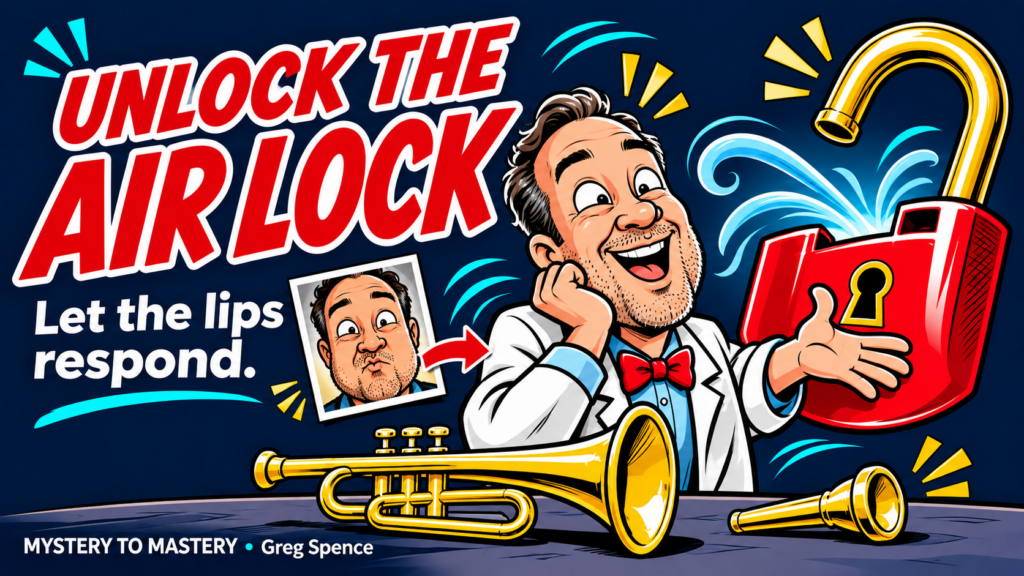
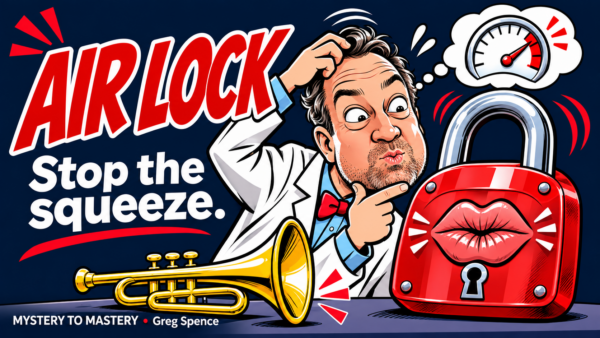 Is Lip Strength the Answer? Unlock the Trumpet Air Lock
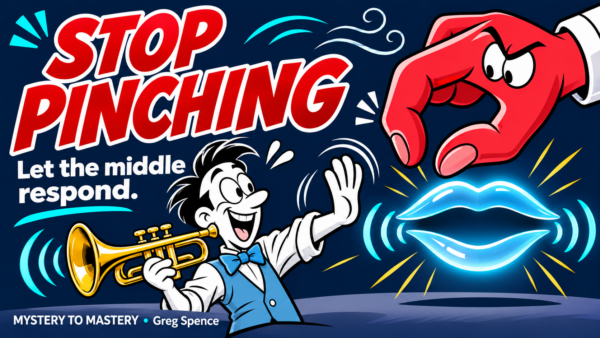 Stop Pinching the Lips: A Short Trumpet Aperture Lesson
 Lip Strength and the Zip Lock: What Trumpet Players Can Learn