Explore trumpet range across three or more octaves with Greg Spence. Watch Air Lock, Lip Zip and passive compression demonstrations without rushing higher.
Read the video transcript
Transcript adapted from YouTube’s automatic captions, with punctuation and readability edits. Demonstrations are indicated in brackets; refer to the video for sounds and movements.
0:00 Hi. Today I’d like to introduce you to a massively important technique called the Zip Lock. [Demonstration.] That was a passive Zip Lock. Here’s an active Zip Lock. [Demonstration.] What is the Zip Lock? If you’ve been around Mystery to Mastery for a while, you will know that the Air Lock is: your lips are so strong in the middle that you can’t even blow them apart. Then we’ve got the Lip Zip, which is: we do the zips up, horizontal movement inwards. That affects the velocity of the air going through the lips, the aperture. The bedsheet top lip, like a bedsheet on a line, vibrates faster when the velocity changes. If we put the Air Lock together and the Lip Zip together, we get the Zip Lock.
1:00 What’s the purpose of the Zip Lock? I’d get you to consider: there is an easy way to play the trumpet and there’s a hard way to play the trumpet. There’s an easy way to create energy in the breath and there’s a hard way to create energy in the breath. There’s an easy way to create oscillation, vibration at the lip tissue, and there’s a hard way to make vibration at the lip tissue. We want to do the easy way, of course. Once you understand how to energise the lungs and get the energy on board—there are plenty of other videos about that—once you recognise the easy way to create energy, I want you to recognise the fact that using the Zip Lock technique proves to you that you already have enough strength to play any frequency on the instrument. Think about that again.
1:57 You’ve already got enough physical strength to play whatever note it is you would like to play on the instrument. At the WindWorks Trumpet Academy we develop over three octaves. That’s what we do, because everyone can do it. We all know that I don’t need to squeeze this balloon out. Passive means I’m not squeezing. I’m not using the thoracic muscles to try and force the air out. I’m simply letting the air come to the pressure point, which in this case is at the lips and the finger. The air pressure, without the throat closing, the pressure comes to the lips, and there’s no leak. That shows you’ve got plenty of strength in your aperture corners. Remember, the aperture corners inside the mouthpiece rim is what determines pitch. You’ve already got enough strength to hold back passive compression, which is very powerful. Then, if we get active and squeeze that balloon, there’s still no leak.
2:56 By doing the Zip Lock exercise, it makes you realise: “Oh, I actually have what I need in the mouth, and I’ve got all the energy I need to play all over the range of the instrument at all volumes.” The question begs asking: what am I doing wrong? What am I doing wrong? I’ve already got the mouth, the lips, the tongue, air, the fingers, the instrument. I’ve got everything I need to play whatever it is that I want to play, my dream avatar. I’ve got everything I need to create that. You don’t need to do anything more. You need to recognise what you’re doing that’s getting in the way.
3:47 What errors am I making? Am I pinching the lips down? Am I closing the throat—throatulation? Am I creating too much energy, overblowing, burning the pizza? These are all the things that we do instinctively that are generally being taught, unfortunately, in most brass worlds. We’re encouraging negative overexertion to try and force out a result, which is simply not required when you understand how to effortlessly create energy, how you’ve got enough strength, and it’s just a little process of finding the right shape in the mouth to find whatever pitch it is you want. How to add volume without going into the instinctive overexertion in the system. Everyone says brass playing is hard work. The reason they say that is because they make it hard work, and it feels like it’s hard work. Therefore it is. It doesn’t have to be. Simple as that.
4:46 If you can learn from the Zip Lock that you’ve already got enough strength to play whatever it is that you want to play—muscle conditioning, endurance, that’s a different thing. You might be able to play that note once or twice until the lips get tired, but that shows that you’ve got the strength in the first place to be able to achieve it. Then we work on endurance and efficiency so you can do it all day long, all night long, with consistency.
5:19 The best thing that you could do now, if that sounds like something that is mildly interesting to you, come and check out the WindWorks Trumpet Academy. It’s at mysterytomastery.com. You don’t know what’s in there. Someone referred to it as the TARDIS recently. It’s like this little blue box, but when you open the door there’s a whole brand new world. Once you step into that, we’re not charging you to enter for a whole week. You can come in and check out the entire course, take from it what you need, find the errors that you’re making. At the end of the week you might choose to leave. That’s completely fine. It will not cost you a cent. Or you might choose to stay, going: “This is really helpful. I understand. Please help me more.” I do weekly masterclasses, do weekly lessons, and I’m here to help you get to the player that you want to be. Come on in and check out the free trial at the WindWorks Trumpet Academy. I can’t wait to see you in there and start changing your playing life. Have a great day. [Music and applause.]
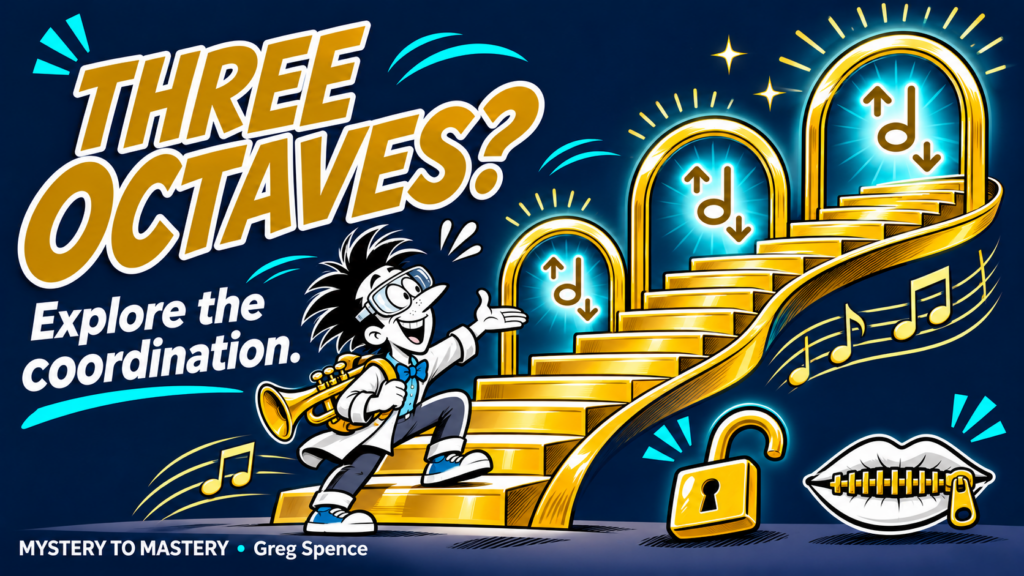
Trumpet range: what does the three-octave lesson explore?
- Explore the purpose of Air Lock and Lip Zip in Greg’s range discussion.
- Hear Greg explain passive compression.
- Consider the role of unnecessary overexertion when working on trumpet range.
Watch the demonstrations, then return to the sections relevant to your playing. Focus on observing the feeling and coordination rather than rushing to reach a higher note.
Video chapters
- 0:00 — Introduction
- 0:26 — Air Lock and Lip Zip
- 0:57 — What is the purpose of the Lip Zip?
- 1:55 — What is passive compression?
- 4:29 — Negative overexertion
- 4:46 — Summary
- 5:18 — WindWorks Trumpet Academy
Originally published in February 2024. Explore these concepts in a structured sequence with the free 10-Step Tune-Up.
Continue exploring trumpet range
- Trumpet Range and High Note Development: Part 1
- Trumpet Range and High Note Development: Part 2
- Browse all free trumpet lessons
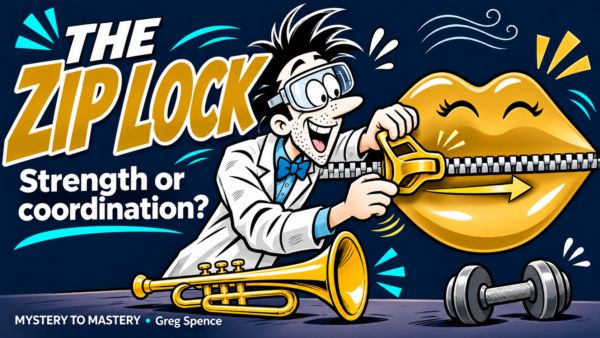 Lip Strength and the Zip Lock: What Trumpet Players Can Learn
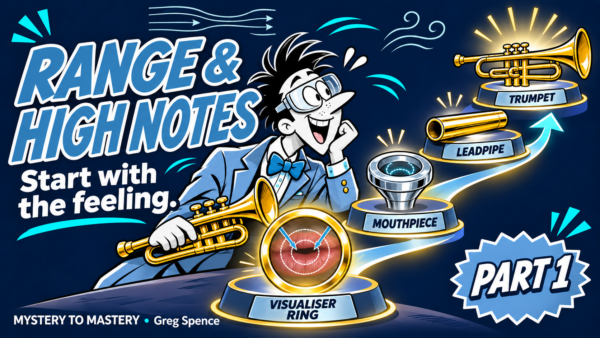 Trumpet Range and High Note Development: Part 1
 Trumpet Range and High Note Development: Part 2