Explore embouchure, passive breathing and coordination with Greg Spence. Discover why he compares brass playing with humming and learning through feeling.
Read the video transcript
Source: YouTube automatic captions, arranged into paragraphs. Captions can contain errors. Refer to the video for precise wording and demonstrations. Dates, invitations and offers reflect the original recording.
Hi, Greg Spence here. I’ve just returned from my summer break and having quite an amusing, entertaining time watching some of the comments on this seemingly uh offensive brass planes no harder than humming uh picture. So, Brad uh Neman, thank you for your comments. The reason that I’m doing a video to you, but to to everyone on this on this link, uh, is because a respectful conversation, and my apologies for coming across as snarky. Snarky is fine. I love it. I understand that what I’m saying is,
uh, sort of counterintuitive. Now all I can say first up before I before I address your uh reply here which is very important is that we can get good results or even great results doing things really inefficiently. There are freaking great players all over the world playing really hard, okay? But they’re great players in getting the result. They’re not going to come to me. They don’t need any of what I’m saying, but they are such a small percentage of the players in the world. Why are
they such a small percentage of players in the world? Why is it that so few people make it to the top level? Now, I was given a mouthpiece and I was buzzing and I was blowing really hard and I’m getting all kinds of lessons about more effort, more muscles, more push, more, you know, buzz the lips and blow hard, smile, blow faster to play high. And on this point, the the logic of brass playing at the moment is blow faster to play higher and blow more
to play louder. So blowing more air is blowing faster in effect. So you got to blow faster to play higher and you’ve got to blow more air, which is faster to play louder. So my question’s always been, how do you play a soft high note? Do you blow fast slowly? I’m not sure about you, but that’s not logical. How do you play a loud low note? Blow slow fast. There’s a real issue with the psychology of the traditional approach to playing. So, I’m reaching out to
people that aren’t where they’re at, where they want to get to because of a misunderstanding. There are three pillars: knowledge, integration, experience. And the knowledge is incorrect. So then the integration of poor knowledge ends up being a bad experience. then I’ve got my subscribers, they’ve got the knowledge, but the big issue is the integration. So that’s why I’m always doing master classes and stuff because we got to guarantee that we’re integrating the concepts correctly because it’s very easy. Human nature is all about get the result,
get the result, get the result, activate whatever you need to to get the result. And that works for some and then even those that it works for quite often break down. So I actually call myself last resort spent because people look at my stuff and either call me a snake all salesman. This is you’re full of [ __ ] This is [ __ ] So on and so forth until they’ve hit that point of well what I’m doing is not working and what he says kind
of makes sense because people when they’re desperate start to look at other information. And I was desperate. I was literally going to quit playing. I was going to quit playing. Even though I was doing theater work, I was doing television work. I got to a professional level. I hated it. Every single note I was playing, I freaking hate it. So, I needed to open my mind or give it away. And as I put in one of the other replies here, I saw Alan Vizuti. Alan Vizuti
playing double tonging quadruple octaves is not playing the way that I was being taught and what most people are being taught is not doing what they were saying. And then I had a lesson off Bobby Shu and he said, “Where’s your air going?” And I went and the air is hitting the floor and he goes, “Got to get your air out straight.” Then he played a triple octave chromatic scale and I went, “That makes sense.” I was so done with my playing that I needed to
make a change or quit. I also I’d never heard of anchor tonging or K modified tonging. So when I read because my my logic brain goes you cannot give up playing when you know there’s a book called Brass playing no harder than deep breathing. Now I’m Australian. We didn’t have much access to a lot of all these different books but I found out about it. I heard it and went who’s this Claude Gordon guy and I researched it. Now whilst a lot of what Claude Gordon
says and I’ve got students of his I’ve seen their PDF that like their handwritten notes and I don’t adhere to either do they now agree with some of the things that he was saying. That’s okay. As you put at the start of your message here Brad I certainly don’t have all the answers. The answers I have are my own experience from using all the methods, right? And then researching the acoustics, the physics, researching the physiology, the ovicularaurus here is a sphincta. You you can’t blow it
apart, but everyone’s airlocking, pinching the chops down, and then you have to blow hard. That’s what makes playing hard work where I don’t have my trumpet here. I’m just going through emails and everything. That’s what I feel like when I’m playing. So, when we understand the mechanics, the body, the body’s role, the oscillation point when we’re humming is the vocal cords, right? And with the voice, if there’s a problem with the sound, we’re not going to use more energy and more power and more air to
fix the problem. With the voice, you’re going to tell someone to relax and back off. But if there’s a problem in the sound on a brass instrument, we get told support the sound, blow more, blow harder. That’s not it. So the less work we do, the easier it becomes, the better it sounds. And then when we understand the what’s happening inside the mouthpiece rim as far as using the sphincta, the ovicular in the right way, then we can skip all over the registers of the horns.
And I demonstrated in the video if you press the learn more button. And I think you might have watched it uh Brad, so I respect you a lot for that. Uh when we put it all together, the reason that I’m sharing this is because of I don’t want other people to to go through what I went through. Absolute confusion, the contradiction of all the methods. So freaking confused. It’s like I’m seeing people play effortlessly. Not very many, but I’m seeing I’m going, how are they doing
that? What what’s going on? what what I’m being told isn’t working because I practiced really hard, too hard. So all of this is a um result of years of frustration, years of limitation. Then the only way I got on to the next level of my playing and traveled the world, now I’m fortunate enough to speak at International Trumpet Guild and Midwest Clinic and all that sharing this with people is because I did things with my own playing and research things that most people will not do.
I will try anything. I will go down every rabbit hole to find out what makes sense logically and what works. And I tried plenty of things that don’t work. But when you think of a basic mechanical system, we’ve got lungs. They’re now full. When we relax, the body wants to go from here to here. There is an oscillation point. M if you’re watching this video, sit at home and try it on your own. And what you will do, most people will go mdominal muscles and tighten
everything up and elevate. The lungs are here. The ribs expand laterally. Then when we relax, if you were here, I’d have your hand on my abdominal wall and you’d feel that nothing activated when I did that. yet it was really loud because I opened up and let go. The body’s role is for long notes and loud notes. If I needed to sustain that long note, I’d have to engage the abdominals because I’m running out of air quite quickly. But passively, and I call it passive because
we’re not active passive breath in, relax. No abdominal activation. Okay? And the same thing applies on the trumpet. We’re simply moving the oscillation point from here to inside the mouthpiece cup. Everything happens inside the rim in here. Right? Range, volume, purity of sound, it all happens in here. But people are using the macro muscles outside of the rim to compensate for a lack of understanding of the refinement required inside the cup. That’s a big call, but I see it every day of my life. When I
get Grammy award-winning players going, I’m broken. I can’t play anymore. Then we go, okay, and have a look at what they’re doing. And the threshold of physical exertion has been breached. And all of a sudden, things start to break down and go backwards. Last resort Spence to the rescue. Okay. So, Mistra to mastery and the Windworks trumpet academy and the 10step tuneup, all this stuff is to try and prevent people from having the issues that I had. I’ve been putting out free um videos and and
uh explanations. I was one of the very very first people on YouTube putting out instructional information. It’s like, who’s this clown from Australia no one’s ever heard of? Now, I’ve written two books and run an academy. And for those that haven’t heard of me, come and check it out. That’s why I’m just saying I’m giving it to you, but I can’t just let anyone come into the to the platform. I’ve got paying members there. So, you got to put a credit card in. And people get
offended by that. But I’m saying do seven days of free lessons rather than 200 bucks an hour for a lesson. I’ll give you seven days of everything I’ve ever learned. And then at the end of the seven days, if you want to stay, a payment will come out. Then even after a month, we’re offering 110% discount. um uh refund if you don’t play the easiest best sounding note you’ve ever played. I I don’t know what more I can do to try and get people to reconsider
uh their approach. Now brass playing is only part of what I do. Like I’m a professional educator. I do psychology. I work with people with musicians vocal donia. I work with sports people. Uh business owners that have to get up and and speak. you know, it’s it’s there’s a whole performance psychology going on. And so what we’re dealing with here with the brass world, that’s just, you know, I’m talking a little bit of technique. So I’m going to get on to you. Sorry, there was 11
minute rant that I didn’t expect to do. However, Mr. Spence, Mr. Neman, Gregor’s phone, I certainly don’t have all the answers. I have more answers now than what I used to have, and I’m always open for learning. I learn from people, not being you’re full of [ __ ] But Greg, I would get you to consider the whole concept of the role of the tongue. I used to think, thanks to Claude Gordon, that the tongue goes higher, so the air goes faster, so you play higher
notes. I’m sorry, that does not roll with physics. The tongue is a part of the uh pitch and sound and range thing, but it doesn’t dictate pitch. Pitch is determined inside the mouthpiece room. Check out the Boni principle. Okay. So, when someone said, “Greg, I’ll get you to reconsider.” I reconsider and I change what I’m saying because I’ve learned more and it makes sense and it’s logical. I’m working with engineers that play trumpet and they go, “Huh, that makes sense.” Because um mechanically minded, they you
can’t argue with what I’m saying. And then I demonstrate it. And you consider getting up at in front of 500 people at Midwest Clinic or ITG conference in Croatia and coming up at Eastman where I’m standing in front of hundreds of people, great players from around the world, and I’m playing from low C to above high C and they’ve got their hand on my abdominal wall and there’s nothing activating. The psychology about brass playing is wrong. And so I’m doing my little best to add to
hopefully the information that’s around. And I understand people are skeptical. There is so much stuff out there. Everyone’s skeptical and it’s smart. So, let me prove it to you. Um, I have plenty of room for improvement in my playing. You may in fact have a terrific system that could help many players. It does. The problem I have is with the statement like trumpet playing is no harder than humming. I understand. So, hopefully that didn’t stop. Physically speaking, No abdominal activation, no kick, no push, sympathetic oscillation
of the chops. It is no harder than humming. Energy flow oscillation sound. Now notice even on the boa straw here and practice on your lead pipe. It’s really cool. Um, it’s it’s harder to sustain the note because there’s not enough compression in the air. So then we have to see that’s passive. There’s no abdominal activation. But if I wanted to get louder, I need to create internal compression. But I’ve got to open the lips that way, not that way. Obviously, I’ll have to leak. Got to
open that way to have greater displacement of the air molecules. It’s very logical. And the orvicularosaurus is a sphincter. You cannot blow it apart, but everyone’s pinching downwards where it should be that way. And I’m seeing a bunch of people uh now that I’ve taught um putting this information out there and doing their own programs. Congratulations. Fantastic. We want the word to get out there. All right. We need people to understand this because the whole concept of tight buzz is the hard way. You can do
it if you want, but hopefully we can avoid you having to visit last resort spins. I don’t normally talk about myself in the third person. Uh, the problem I have with with statements is harder than humming. The reason that bothers me is because especially young players see something like that and believe your system of some kind of magical quick fix. I haven’t said that it’s a magical quick fix. But what I have I get all of my students and I had a 12-year-old yesterday. My girlfriend’s
got a 12-year-old son. I’ve been teaching since he was about seven. And I get them to understand how to breathe correctly without doing the mircat, tightening up, lifting up, drop, expand. That’s number one. Then I get them to recognize the feeling because here’s your sound back here. Everyone’s blowing through the horn, trying to get the the sound out through the bell. I let the sound come back in to a concert hall. That’s all explained if you’re interested. Do the 10step tuneup. Um, but I get there
and sit there and get them to hum literally. Why? Because that’s the feeling that I want them to have. We’re showing the brain. The brain learns from the feeling. It doesn’t learn from reading ink in a book. It doesn’t read from hear. It doesn’t learn from hearing information. It learns from experience. Now, the traditional um teaching is kind of like here’s a note to see the ink and then play the ink and get the sound. And most beginners get a terrible sound and because they’re pinching
their chops and blowing too hard. So, you got ink, then you got sound and then they store that feeling, right? So, even if they get a good sound, consider this. You get the good sound and the the brain stores that feeling, but the process behind it’s terrible. It’s so massively overexerted. So all I teach is the feeling first. Then we add sound without compromising the feeling. I got a flowchart demonstrates it. And then we add ink. And I call it inkitis because all of a sudden
you got ink in front of you. And the demand of playing overwhelms the brain. and all of a sudden our efficiency processes go out the window. So we have to keep working on the efficiency processes based on the feeling because that’s what the brain stores to learn the process. So if people are having trouble they’re working too hard or they’ve got a um like a issue with the belief system by limited beliefs. I don’t think I can actually be better. Brass plane’s hard work. They’re gifted.
They’re lucky. They they were born with special. It’s all crap. Everyone can do this. So, I’ve got limiting beliefs. What’s the first thing you’re going to do when someone comes across and says, “Hey, you you’re probably playing a bit too hard. Brass playing’s actually no harder than humming.” We get defensive. I’d made it to the top. You know, I was playing professionally and I was still really pissed at my playing and hated it. So, I’m going to stop. And it’s only because of all this stuff
that I’ve learned from hours and hours and hours and hours of emails to people doing um acoustics and uh you know all sorts of stuff. Doctors from acoustics departments in universities all over the world. Lots and lots. I’ve got I went through my shed the other day. I got folders and folders of my research from back when I was doing it before I put book one out which was 2004. Once we understand knowledge our our refined mechanics uh then the integration is based on the feeling.
So I get everyone hum and let go. We we want to eliminate any involuntary or unnecessary muscle activation. Does that make sense? Eliminate any involuntary or unnecessary muscle activation. Meaning, don’t use what you don’t need until you do need it. And as you can see, I’ve done that with singers and they’ve got their hand on my abdominal wall and nothing grabs and they’re like, it’s like they’ve seen a ghost, right? Because the understanding of how we go about creating sound. And again, that’s not to say
that we don’t use the abdominals. We do. That’s for long notes and it’s for loud notes. Pitch comes from either here with the voice or inside the cup. The body’s role is to sustain that pitch. And opening vertically is how to uh get more volume, more displacement without affecting pitch, which is horizontal. So, we’re teaching everyone, not just beginners, the feeling of efficient playing. So, I could put this video on the uh on the label there, but who’s going to watch it, right? So, that’s why
I’ve kind of got it. I’m suggesting the brass plane can be as easy as humming. And then it’s whether people go, “Oh, that’s interesting. I’m curious about that.” And click the button and have a watch and thank you for watching the video. But in no um no place did I suggest that it’s a magical quick fix. I’m saying there’s a more efficient way to play. While there is most definitely I want to make sure this doesn’t turn off. While there is most definitely pedagogy that can
help trumpet players. While there is most definitely pedagogy that can help trumpet trumpet players and yours might be included in that. I guarantee what I do is like nothing you’ll find anywhere else. In my honest opinion, there are no shortcuts. So there are shortcuts. The shortcuts are don’t do it the hard way. I went down the hard way and most people accept mediocrity and I can say mediocrity as a professional player. I’m a mediocre pro. No, I’m I’ve I’ve got pictures. I’ve got photos with Charlie
Davis and Artur Sanderal and Bobby Shu and James Morrison. You name it. I met them all inspired by them. I wanted to play with him. Now I’ve played on tour with with um with uh James Morrison, Bobby Shu. I played lead trumpet in the Texas All-Star Big Band um for the International Trumpet Guild come and Caruso Jazz competition in Texas. I would never have done that if it wasn’t for learning efficiency because the all strength method wasn’t working for me. It’s very simple. Our muscles are
too strong. Once you choose to lock that sphincter down, that ovicularis orus blow as hard as you like. You can’t blow it open. Right? So when we refine, refine and refine the processes, which I do with all of my students and all of my subscribers is let’s do it easier. It’s just logic. It’s just very very logical. And what we’re doing is actually discovering learning what not to do. Where am I starting to activate that I don’t need to. Where do I start to lock up?
Who’s the clicking in the throat? I call it throiculation. There’s a clicking. You hear that all the time. Inconsistent pitch. Um, running at endurance is crap. And always endurance and range tend to come together because it’s efficiency. But once we understand the mechanics, you can be as strong or stronger at the end of the gig than what you were at the start because you’re using the muscles in the right way. And people used to ask me, Greg, you never talk about efficiency and you you can
keep playing all day long. It’s like, well, I’ve never thought about it, but it was the byproduct of correct technique. Everyone can do this, but it’s not natural instinct. The brain wants to survive. The caveman wanted to kill the saber-tooth tiger to eat. It’s not thinking about pure technique in throwing the javelin or throwing the spear. But we can’t use brute force on brass instruments. Some people get away with it, but it’s a minority. So this year is the year I’ve changed the mystery MTM to
M2M. It’s the second phase. I’m coming out all guns blazing. I can’t wait to get to Eastman for the International Trumpet Guild. Talking about a learning process that relates to musicians vocal donia, which I won’t go into here. Performance anxiety, which I don’t believe in performance anxiety. In fact, it’s deeper than that. Stage fright, I don’t believe in that. It’s deeper than that. And I used to have serious nerves issues. It’s a whole different story. And uh brass playing, destonia, performance anxiety, learning the trumpet. The
process of training these are all the same. It’s a very powerful learning process. And that’s what I’m speaking about at the conference in in Rochester, the 50th anniversary of ITG. What an absolute thrill for this Aussie guy who 20 years ago was so frustrated, started researching, and now I’m talking on the bigger stages. So I understand that this concept is challenging but if we dive a little bit deeper really understand it go huh okay I’m prepared to put aside my previous beliefs in order to get
a better result for myself or for my students and I was more than happy to put everything aside of everything that I overthought because I was not the player that I want it to be. It’s really simple. There’s no ego attached to this. It’s experience and it’s a desire to share. Um, yours might be included. In my honest, in my opinion, there are no shortcuts or internetbased programs that will replace dedicated practice and study with qualified teachers. I have a very big issue with that statement
because there are plenty of qualified teachers that have no idea what they’re talking about. Sorry to say it. It’s true. they are sharing 150 year old information that the percentage of players you you’ll get some good players and they’re the ones that make it through. But what I’m not worried about the people that make it. I’m not worried about the people that are happy with their playing. I’m not worried if someone’s really efficient or inefficient. If they’re happy with their playing, they can play out their
ear and squint. If this worked and they’re happy, do that. Simple. But if we’re having problems, we’re not the player that we want to be. We have to ask why. Then you’ve got to have a determination to succeed. Laser focus on why can’t I do this? I had someone reply once, range is based on genetics. It’s got nothing to do with it. Some people naturally might play high more easily. We could talk about the whole Wayne Berseron thing and French horns and all that sort of
stuff. I’ve played next to Wayne as well. Some people will just pick it up and play it. Most won’t. So, I’m looking at those that are struggling, those that want a bit of a lift up, bit of help. Uh, that’s what teaching is, finding the issue that the individual player is having. And that’s why people with donia came to me because I break it down. It’s just logical. Can you sit in stillness in silence? Or have you got an impatient brain? Then when we start to
activate muscles and do active things, are we doing it efficiently or inefficiently? It’s very, very logical. It’s why there’s 10step tuneup. You don’t have to check it out. No one has to check it out. But they’ll I say in there, you will play the best sounding, easiest note you’ve ever played if you do it. It’s really simple. I back it up. I guarantee it. If you don’t, I offer free sessions through the platform to see where you’re going wrong because there tiny tweaks and all of
a sudden you go, “Oh, you really meant oh, you really meant that, huh? Oh, that feels different. That’s the easiest I’ve ever played. If I had a dollar for every time I’d heard that, I’d be calling you from Bahamas, not Cool Beach.” Uh there are shortcuts. Don’t do it the hard way. Internetbased programs that will replace the way I go about this is learn the technique. I’ve done it with everyone that I teach online. I’ll teach you the knowledge and the skills and drills to integrate
and you will get the experience. But I encourage all of my online private teachers, private students to go to a professional player to learn quality of sound. We must have an amazing sound model in order to, you know, get the result. Now, of course, what happens soon as they hear the the great sound and they try and make that sound, they’re going to overexert. So that’s the balancing act that we’re working on. Refinement of technique to get the result that we want. So it’s a very
fine line, but we learn it early. And again, my junior students who are coming up and then all of a sudden going on and playing in orchestras and they’re playing efficiently or big band whatever any it doesn’t matter. Doesn’t matter what instrument. It’s a learning process. It’s based on physics. It’s universal. It’s not trumpet. But I’m a trumpet player. So, it just so happens that I put my expertise into a trumpet and brass academy, but I taught myself to play golf left-handed and was club champion
within two years. And I’ve never played golf left-handed. I don’t do anything left-handed. It’s a learning process. Uh but definitely a qualified teacher who is good, who has a great sound, who knows uh how to pick what the individual student is doing wrong is gold. a qualified teacher who is saying, “Here’s the book. Here’s the mouthpiece. Bud your lips, blow hard, get it sound like this with with zero um attention to the process and creating a sound is going to have a high fail rate. And
by fail, I mean unhappy players that don’t make it to the level that they need to be. So, I will stop. um yes, dedicated, yes, um qualified teacher, but again, as I say, I’ve met a million qualified teachers that qualified, but they’re they’re just repeating the old stuff. It’s it’s just not it. My apologies for becoming snarky across as my apologies for coming across as unnecessarily snarky. I love it. It’s all good, Brad. We we’re we’re here to help people. All right? I don’t want people
to go through what I went did. And when I discovered the things I I discovered, I went I need to share this. I was literally writing a book like a excuse me, I was writing a bunch of exercises for my Melbourne University students right years ago. I’m going to document this for my students at the uni. And then when I started to really put together what I was discovering, I went, I need to do this bigger. And then so I wrote book one, James Morrison and
Ellen Vazuti uh endorsed it. Book two came in 2010 and then it’s like whilst there was sound on the CDs and the ink, it didn’t give me the opportunity to assess whether people were doing it right. And that’s where wind works came from. I need to see people. So I do weekly master classes. I want people to play easier and I don’t want them to have the problems that I had. It’s very simple. I’m going to shut the hell up now. To everyone, if you’re still
watching and you’ve been on this link, bring on the abuse. Monday Magpie Madness is coming. We’re Aussies. We’re used to getting attacked. So, we got pretty tough skin. Um, yeah, take a closer look. Come in, check it out. Won’t cost you anything. If you love it, stay. And even then, 15 bucks a week in 12 months time, that’s if you stay for the year program, you’ll be so much a better player and will have overcome problems. You you won’t believe it. But you won’t know until
you try it. As I say, if you haven’t tried pineapple on pizza, don’t be pineapple on pizza. Might be delicious. Have a great day, guys. Uh we’re trying to make this a better experience globally. Get on board. Don’t miss out. Ciao.
Embouchure: 3 ideas this lesson explores
- Explore Greg’s reasons for changing his teaching methods.
- Consider passive breathing and the distinction between passive and active playing.
- Connect embouchure coordination with the wider playing system and the experience of feeling.
Watch the demonstrations and explanations, then return to the sections most relevant to your playing. Use the lesson as a starting point for understanding the process, rather than rushing through another exercise.
Video chapters
- 00:00 — The traditional approach
- 02:25 — Why I changed my methods
- 04:22 — Physics of brass playing
- 06:20 — The power of passive breathing
- 09:46 — WindWorks Academy
- 11:43 — Reconsidering the tongue
- 13:54 — Passive and active play
- 16:22 — Learning through feeling
Event invitations and offers mentioned in this recording relate to the original session. See Sunday Sessions for current information.
Continue exploring
Explore the WindWorks Learning Loop and its three pillars: Knowledge, Integration and Experience. You can also browse the free trumpet lesson library.
 Start With Stillness
 Practise No-Notes
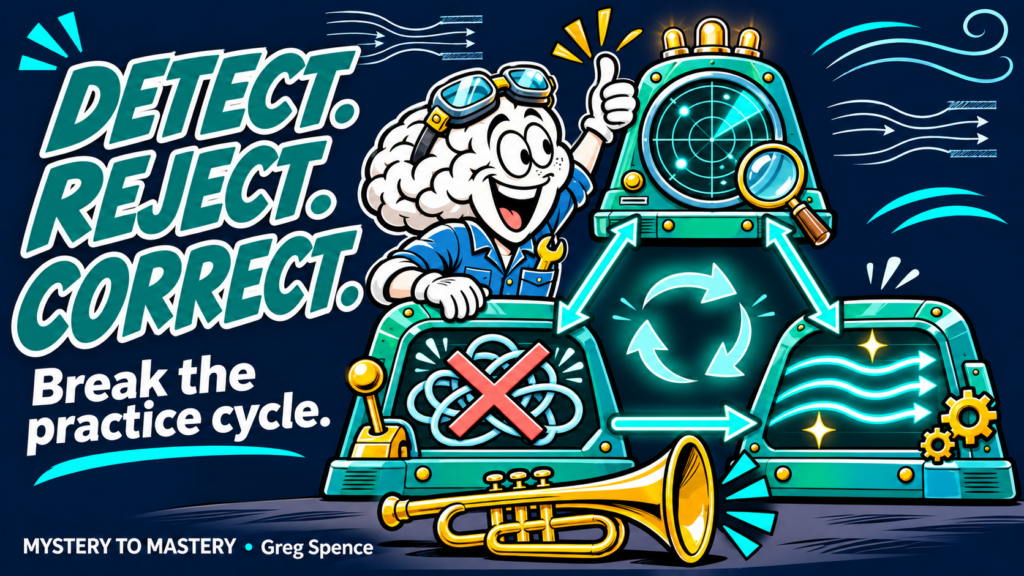 Detect, Reject and Correct