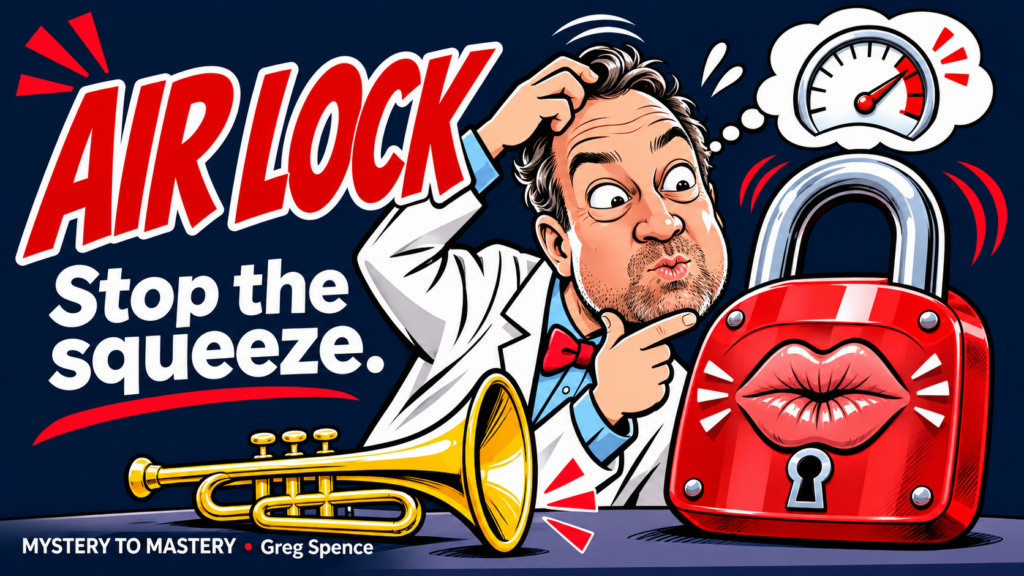
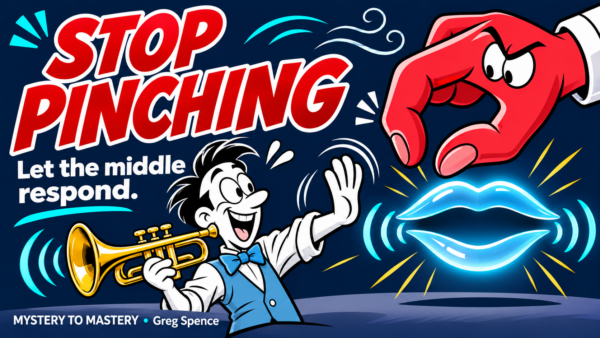
Is more lip strength always the answer? Greg Spence uses the Air Lock demonstration to question that assumption. Watch how he contrasts a pinched closure with the aperture corners, Bed Sheet and Milk Spout concepts.
Read the video transcript
Source: YouTube captions, formatted for reading. Captions may contain errors; refer to the video for precise wording, sounds and demonstrations. Dates and offers reflect the original recording.
good day Greg speds from Mystery to Mastery here today we’re going to unlock the biggest obstruction to your plane the biggest obstruction to playing freely all over the instrument the obstruction to efficiency and that obstruction of course that we’re going to unlock is the airlock the airlock of the lips pinching down top lip bottom lip squeezing together there is a psychology that we have to buzz the lips and tighten them up when we’re playing higher and all this does is actually increase the air lock what is the air lock if we put the lips together
pinch them down p p p pinch blow as hard as you can you cannot blow the lips apart there is so much strength in the omuser especially around the middle of the lips there that you simply can’t blow them apart this is a massive error that just about everyone makes and it comes from a misunderstanding of how the instrument works and what we think we need to do so how do we overcome that I’ve got a concept called the milk spout I’ve got a concept called the aperture Corners the corners of the aperture not the
corners of the mouth I’ve got a concept called the bed sheet and once we understand those Concepts those amazing tools that we use in the course you’ll start to recognize that the pinch is the opp opposite of what you actually need to be doing the middle of that top lip and some people often say just the skin on the top lip there needs to be like the bed sheet when the breeze blows they respond so to unlock your limitations and obstructions in your playe you really must discover how to let go unlock the lips let
the lips go and let them respond sympathetically to the the energy in the Airstream we use the Aperture Corners to do that we use the milk spout and the bed sheet these are really important tools that I use with all of my students and you can use them too so what I’d highly recommend is to come and jump on into the course 7 Days won’t cost you a Cent and start and learn about how to use the Aperture Corners the bed sheet and the milk spout to unlock that dastardly dreaded airlock it’s massively powerful and
I’d really love you to come and discover this
Is more lip strength always the answer?
Greg calls the Air Lock the pinching together of the lips that obstructs their response to the airstream. In this lesson he contrasts that squeeze with the aperture corners, bed sheet and milk spout concepts.
This recording is part of Greg Spence’s public teaching archive. References to dates, events and offers reflect the original recording.
Lip strength or coordination? Explore Greg’s comparison
Lip strength: what does the demonstration ask you to reconsider?
When a note feels difficult, “I need stronger lips” can seem like an obvious explanation. Greg uses the Air Lock example to question that conclusion. The lip strength example uses closed lips resisting the air, demonstrating strength in an action that is also obstructing the response he wants. The next part of the lesson concerns how to let the lips respond more freely.
This guide keeps that argument in view. It is about understanding what Greg’s comparison shows, which question it raises and how the connected concepts fit together. Watch the original demonstration above before drawing conclusions about a particular difficulty in your own playing.
Does the lip strength example show weakness or resistance?
Greg begins by pinching the lips together and showing that they cannot easily be blown apart. He presents the resistance as a reason to question the assumption that the lips lack strength. Simply adding effort against the same closure would not address the problem he is describing. The example changes the question from how hard you can work to how the action is organised.
Notice that resisting the air and producing a musical response are different tasks. The demonstration is useful because it makes that distinction visible. Greg then connects it with his explanation of how the lips can respond sympathetically to the energy in the air stream.
Why can a lip strength assumption lead to more squeezing?
If a player interprets difficulty as weakness, the natural response may be to tighten more. Greg explicitly connects the Air Lock with a belief that playing higher means buzzing harder and tightening the lips. That belief can encourage more of the very closure he is questioning. Listen for this psychological part of the explanation as well as the physical demonstration.
The useful point is to examine the assumption before choosing the response. A frustrating result tells you that something needs investigation; it does not identify the cause by itself. Greg offers a particular comparison to help make that investigation more specific.
Is the lip strength comparison an instruction to blow harder?
Follow the complete sequence. Greg uses resisted pressure to illustrate the closure, then turns toward unlocking the lips and allowing a response. Stopping at the first example would leave you with only the obstruction he is discussing. The purpose of the lip strength example becomes clearer when you watch the contrasting explanation that follows.
This is why the lesson should not become an effort contest. The lips do not need to win another argument with the breath. Greg is asking you to reconsider what is getting in the way, rather than keep increasing force against the same pinched action.
Where do aperture corners fit into the lip strength question?
Greg names the aperture corners and makes a specific distinction: these are the corners of the aperture, not the outer corners of the mouth. That directs attention toward the opening involved in the response he is discussing. It gives the explanation more precision than a general instruction to build stronger facial muscles.
The related short aperture lesson provides another view of the movement. It contrasts a downward clamp with inward movement while the jaw stays down. Use that video if your next question concerns what Greg means by the alternative coordination. This strength comparison and that movement demonstration can clarify different parts of the same discussion.
What does the Bed Sheet add to the lip strength explanation?
Greg compares the middle of the top lip with a bed sheet responding when a breeze blows. This image gives him a way to describe responsiveness, in contrast with the held clamp. It helps connect the strength example at the beginning with the different response he describes later in the video.
The metaphor is a teaching tool, not a measurement of how relaxed or strong every player should feel. Watch how Greg uses it in the explanation. Its value here is the comparison it makes possible: the lips can have strength, while the response he wants involves something more specific than applying a stronger squeeze.
How does Milk Spout relate to the lip strength question?
Milk Spout is one of the connected concepts Greg names, alongside Aperture Corners and Bed Sheet. He points viewers toward learning how to use these tools in the course. This short recording does not fully demonstrate every detail of each concept. Treat an unfamiliar name as a question to explore, rather than inventing a physical instruction from the label.
For the lip strength question on this page, the important connection is Greg’s purpose in naming the tools. He is showing that there is a way to investigate coordination and response after questioning the assumption that weakness is always the limiting factor.
Does lip strength mean the same thing as endurance?
In the linked Zip Lock lesson, Greg distinguishes having enough strength to produce a result from sustaining efficient playing over time. That separate explanation helps put the strength question in context. Being able to resist pressure in one demonstration does not describe every aspect of conditioning, endurance or consistency.
Keep the questions separate when choosing your next lesson. This video concentrates on the obstructing closure and the response Greg wants you to understand. Zip Lock develops the relationship between the concepts and includes the strength-versus-endurance discussion. The related cards below let you move directly to the explanation that addresses your next question.
Can this lip strength demonstration diagnose my playing?
This lip strength video introduces an idea and shows a comparison. It does not establish which action is responsible for every individual player’s difficulty. Recognising Greg’s example and identifying what happens in your own playing are connected learning tasks, but one does not automatically complete the other.
You can begin with a precise observation: what action does Greg show, what does he say it demonstrates and what alternative does he describe? If a detail remains unclear, return to that part of the recording. A specific question about the example is more useful than turning a difficult note into a verdict about your ability.
What is a useful way to summarise the lip strength lesson?
Try separating three parts of the argument. First, closed lips can offer considerable resistance. Second, Greg uses that observation to question the automatic assumption that more strength is required. Third, he directs attention toward unlocking the closure and learning to use the connected concepts.
That summary leaves room for the rest of the learning process. It does not turn the video into a new strengthening routine, a fixed mouthpiece position or a promise about every note. Keep your summary close to what Greg actually demonstrates, then use the next lesson to explore the part you want to understand more clearly.
What can I explore after this lip strength comparison?
The transcript is useful for revisiting the wording, while the recording provides the movement and sound. Captions can contain errors, so check the video when a phrase looks unfamiliar. References to the offer in the recording belong to its original context; current course information is on the website.
If this lip strength comparison has challenged an assumption about your playing, the free 10-Step Tune-Up offers a guided introduction to the WindWorks learning process. Use Start My Free Lessons for the current introduction. Take the question raised by the video into that process, and allow the demonstrations to become clearer through the connected explanations.
Continue exploring
Browse all free trumpet lessons or continue with a related lesson.
Watch the original lesson on YouTube.
 The Air Lock: Stop Pinching Your Trumpet Sound
 Lip Strength and the Zip Lock: What Trumpet Players Can Learn
 Stop Pinching the Lips: A Short Trumpet Aperture Lesson