Practise no-notes to observe your breathing, body and instrument movement before adding sound. In this video, Greg Spence explains why noticing unnecessary effort can be easier when producing a note is not the immediate goal.
Read the video transcript
Source: YouTube captions, formatted for reading. Captions may contain errors; refer to the video for precise wording, sounds and demonstrations. Dates and offers reflect the original recording.
good day Greg speds here welcome to Mr to Mastery one of the massive things that makes us different to anything else that you will find anywhere is the practice of playing no notes and you’ll be like what on Earth a no notes green no notes are one of the most powerful exercises that you can possibly do if our brain has the intention of playing notes there is a list of errors as long as your arm that get involved to try and manipulate to play sound we don’t need to have all these errors over manipulations and
most people don’t recognize they’re doing them even professional players that I sit next to amazing players but really inefficient that have a bunch of errors in their playing that don’t need to be there if you’re a beginner make sure that you don’t start and develop these bad habits if you’re an intermediate player great time to get rid of them if you’re an advanced player this is where the magnifying glass has to come out to really look deeply into what you’ve been doing for a long time sure you’re playing at a high standard but you know
that there’s something in the system that’s just not right so what we need to do is play by feel we need to understand the feeling of efficient playing and that’s what nonotes is all about it gives us an opportunity to observe our processes when we’re playing picking up the instrument taking a breath relaxing the body releasing the energy but there’s no note happening on the instrument now if I jump straight ahead and play a no note most people watching go well that’s got nothing to do with playing the instrument at all that’s why we’re different
because when you recognize the massive awesome power of what I just did then you’ll recognize it gives you an opportunity for you to scan the body and figure out exactly where you’re activating that you don’t need to there are a lot of elements that I’m doing here firstly it’s just the elbows and the rotated cuffs of the shoulders there’s nothing else moving in the body now recognize that I’m taking a a breath and I’m talking but it’s almost effortless the hardest part’s taking the breath in now people will go that’s miles away from playing because
you have to blow the instrument you’ve got to buzz your lips to which I go no you don’t have to do that at all when you begin to understand how the aperture Corners work not the sides of the mouth everyone gets confused with the corners meaning here it’s not the corners of the mouth it’s the aperture Corners when you learn how the aperture Corners work work and they control velocity then the bed sheet top lip and the milk spout bottom lip when you understand these Concepts you will recognize that simply using the energy from the
breath like I’m doing now when I’m talking but bring the instrument up elbows rotate a cuff breath set release you can tell yourself that’s what it feels like to play and you have a look at what Brian the brain says when you go to do that you try and tell him that that’s all you need to do to play and he’ll go now playing is a lot more hard work than that that’s why we’re different when you understand the upper your Corners it’s absolutely no harder than sitting here humming or talking all we’re doing is
learning the feeling of playing so when you start to convert from the no notes to playing notes you will be able to observe what you’re engaging in the body unnecessarily to create that sound then with the psychology and the understanding of the mechanics that I demonstrate to you and explain to you you’ll start to recognize that these extra manipulations that you’re using to try and create the sound are actually unnecessary errors that take away from your efficiency inefficiency is what limits people’s range endurance flexibility tone all of these things the hardier work the harder work
it is and people think trumpet playing is hard work and brass playing hard work and let me tell you I cop a bit of grief when I say brass playing is no harder than humming talking or singing But as I’ve just explained there when you know the feeling of no notes there is actually no more work involved in playing those notes than what there are in the no notes you get your head around the no notes and you’re going to unlock so many inefficiencies and overcome so many obstructions in your playing you’ll ask yourself why
have I been doing that for so many years just try it it’s my own experience you don’t have to believe me you have to try it for yourself and then recognize what’s going on in your playing the only way I got to travel the world as a professional player was unlocking my inefficiencies and learning how this damn thing actually works not what the traditional methodology of buzzing and blowing hard taught me over many many years so the best step you can take right now if you want to achieve that dream avatar for you to get
the results that you want is to accept what I’m offering to you which is 30 years of research in fact it’s 20 years this year since I released book one and all I’ve done from those 20 years ago besides playing all around the world is teaching and refining all of my understandings and discoveries I experimented so you don’t have to let me share that with you you can have it all for seven days we’ll quickly set up your Prof file and within a minute from now you’re going to be in the course and starting to
discover all of these techniques that I’ve got to share with you have a great day and I look forward to seeing you in the course
Explore Greg Spence’s no-notes approach: observing the breath, body and movement of bringing the instrument up before adding a played note.
Why practise no-notes before sounding a note?
Removing the demand to produce a note gives the player an opportunity to observe breathing, movement and unnecessary effort. Greg then uses that familiar sensation as a reference when sound is added.
Three things to observe as you practise no-notes
- The breath: notice how the inhalation and release feel without the demand to produce a particular pitch.
- The body: watch for extra activity that appears when you prepare to play. Greg’s demonstration gives you a reference for comparison.
- Bringing the instrument up: observe the movement itself before combining it with sound.
These are observation points drawn from the video, not a replacement for Greg’s full demonstration. Watch his sequence before comparing the no-notes sensation with playing a note.
This recording is part of Greg Spence’s public teaching archive. References to dates, events and offers reflect the original recording.
Continue exploring
Browse all free trumpet lessons or continue with a related lesson. You can also watch Greg’s original no-notes video on YouTube.
 No Notes Practice: Discover the Feeling of Efficient Trumpet Playing
 Stillness: Learn to Notice Unnecessary Effort
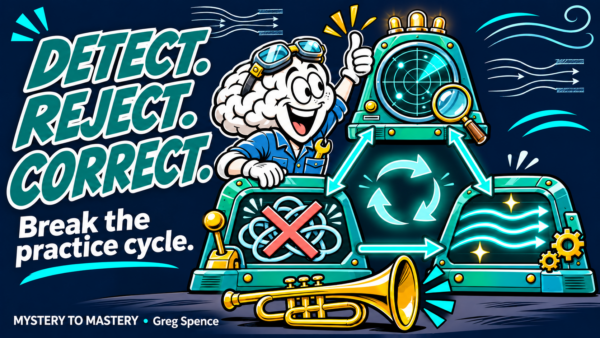 Trumpet Practice Not Improving? Detect, Reject and Correct Your Errors